
Inside the Film: Composer & Director Richard Blackford on La Sagrada Família Symphony
Updated: Oct 5
To mark the centenary year of Gaudí’s death, renowned British composer Richard Blackford took on a new creative challenge: translating the architectural magificence of La Sagrada Família into an imposing three-movement symphony and accompanying film.
The symphony, which takes its structure from three of the basilica’s great facades, has been praised by critics for its invention and imaginative scoring — described as a successful homage both to a unique moment and its architect.
Fresh off the premiere of La Sagrada Família Symphony on Arts Biography Channel’s YouTube, we spoke with Richard about his new departure into directing, Gaudí’s timeless creative vision, and taking inspiration from nature.

Arts Biography Channel (ABC): When did you first visit La Sagrada Família, and what was your immediate reaction to it?
Richard Blackford: I first visited La Sagrada Família in the early 90s, when it was a construction sight with forests of scaffolding everywhere. The public were allowed to only see a very small part of the building, but even then you had a sense of the enormous scale of Gaudí’s vision. I then returned in 2018, at which time the interior was complete. I was amazed at the beauty and originality of the architecture, modern and yet timeless.
ABC: You’ve described wanting the symphony to stand alone as a homage to Gaudí, what about him inspired you?
Richard: It was the scale of his imagination, his Christian faith and his unwavering belief that his vision would one day be realised, even though it took a hundred years that inspired me. I love the fact that he knew he would not see its completion in his lifetime, just as many of the architects and builders of the great mediaeval cathedrals also knew they would never see their work completed in their lifetimes. The idea of creating something magnificent for others to then take up, to work on for decades, and finally complete is for me a moving and compelling idea.
"The idea of creating something magnificent for others to then take up, to work on for decades, and finally complete is for me a moving and compelling idea"
One Symphony, Three Facades
ABC: You chose to structure the symphony around the three façades — Nativity, Passion and Glory. How did you translate their visual and spiritual differences into three musically distinct movements?
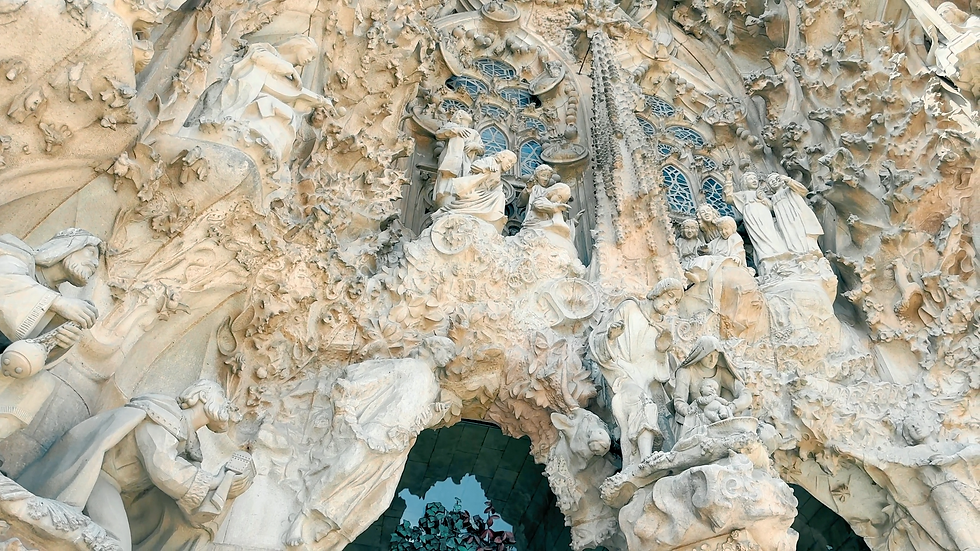
Richard: Each of the three facades prepares the visitor for a different experience of the basilica. Gaudí lived to design and complete most of the Nativity, with its lovely depictions of the birth of Christ, surrounded by animals of every kind. By contrast, Josep Subirachs’ Passion facade is harsh, angular and brutal, and this suggested to me a music that would be in complete contrast to the Nativity movement. The Glory facade only existed in design form at the time I wrote the symphony, so I focussed instead on the miraculous stained glass windows that flood the basilica with coloured light from every angle. I wanted the impression of the final movement to be a celebration of the spirit of Gaudí’s masterpiece, with the music evoking bells and the glorious sound of organ pipes.
ABC: The Glory façade, the most important of the three, inspired your shortest movement. Can you talk us through that decision?
Richard: The movement opens with a horn solo, almost like a plainchant, as if sounding high above the basilica in the sky. The lower tones of the orchestra appear as we imagine the descent into La Sagrada Família, flooded by the coloured light of a thousand stained glass windows. The plainchant is developed by the orchestra until it bursts into an incandescent texture that incorporates bells and the great pedal notes of the organ. This movement, the shortest, is less descriptive than the first two, but more like a meditation on the spiritual nature of the building.
ABC: Gaudí drew deeply on nature — tree trunks, light, organic forms — in his architecture. Do you find nature influences your compositional language in a similar way?
Richard: I do. I was immediately attracted to Gaudí’s insistence that the natural world be represented in every aspect of the building: from the great internal pillars that are like enormous trees, to the many animals depicted in the Nativity facade, to the forests of light created by the stained glass windows. His wish that his life’s work be in harmony with nature reminded me of St Francis of Assisi. In my music there were images that translated themselves naturally to music: the opening angel trumpeters, the children playing musical instruments at the Nativity. But in the Passion movement I wanted to depict the darker side of Nature, especially the apocryphal storm that accompanied the tearing of the Veil of the Temple. Though we did film some thunderstorms around La Sagrada Família, we had to supplement with some incredibly dramatic footage of lightning and violent cloud formations from a video stock library.
Behind the Scenes: The Making of the Film
ABC: How did the process of directing the film change the way you thought about the symphony, if at all?
Richard: I was fortunate to find an excellent videographer Lorenzo Vecchia, who also was a licensed drone operator. We had several reconnaissance trips to Barcelona, going over my storyboard and creating a detailed shot list for the three movements. I then recorded the symphony with BBC National Orchestra of Wales and we then knew exactly how long each section lasted and how many shots would be required. In the Passion movement, for example, there is much fast intercutting, so we had to shoot a lot of material. By contrast, the Gloria movement has long, gentle sequences of the interior windows and the visual and musical rhythm is quite different. As is often the case, much of the film was created in the editing room. I was fortunate to work with Oliver Starkey, who is also very musical, and we sat for hours with the soundtrack as we assembled the images and matched them to the symphony.

ABC: Directing the film was a new departure for you — what drew you to making it yourself rather than handing that to a filmmaker?
Richard: As I returned many times to just sit in the basilica for hours on end, I kept having visual images that became inextricably linked with the musical ones. I have had much experience writing music for films and my understanding of that delicate relationship gave me the confidence to piece together a storyboard of images that the music would evoke.
"As I returned many times to just sit in the basilica for hours on end, I kept having visual images that became inextricably linked with the musical ones"
An Unfinished Masterpiece
ABC: La Sagrada Família has just reached a milestone many thought they’d never see — the Tower of Jesus Christ completed and blessed by Pope Leo XIV, in the centenary year of Gaudí’s death. Does this moment give your symphony a new resonance? And given that the Glory Façade that inspired your finale still has years of work ahead, does any part of you feel the story isn’t quite finished either?
Richard: Many Spanish people think that the building will never be finished, that it will always be a work in progress. I like this concept. I think that the completion of the Tower of Jesus does give opportunities for my symphony and film to be part of the celebration of Gaudí and La Sagrada Família. I also sometimes wonder about adding to the film in a few years once the Gloria facade is complete, but who knows when that might be?
Experience Richard Blackford's La Sagrada Família Symphony & film, now streaming on Arts Biography Channel's YouTube

